



Cando Cushy-Air Ball (Red, 10 inches)
The Cando Cushy‑Air Ball is a small inflatable exercise ball designed for hand‑ and grip‑strengthening exercises. It is manufactured from a soft, cushioned material that is easy to grasp and provides comfortable resistance. The ball measures 10 inches (25 cm) in diameter and can be inflated or deflated to change its firmness. Because the ball weighs only 0.5 lb, it is light enough for children, seniors or people with limited strength to handle during therapy sessions. This product comes in several colours; the red ball is shown here.
Why choose the Cushy‑Air Ball?
-
Soft and easy to grasp – the cushiony material gives the ball a gentle texture that makes it comfortable to hold.
-
Hand and grip‑exercise tool – therapists use the ball for simple hand‑ and grip‑strengthening exercises.
-
Adjustable firmness – users can inflate the ball to its full 10‑inch diameter or deflate it slightly to increase or decrease resistance and firmness.
-
Portable – the 10 inch size and light weight (0.5 lb) make it easy to carry and store.
-
Bright colours – available in red, green and yellow (each colour has its own SKU and UPC) to suit different preferences.
Specifications
| Parameter | Specification | |
|---|---|---|
| Diameter | 10 in × 10 in × 10 in (25 cm) when fully inflated | |
| Weight | 0.5 lb | |
| Material | Soft, cushioned vinyl (easy to grasp) | |
| Inflation/deflation | Inflate to 10 in or deflate to adjust firmness | |
| Colour options | Red (UPC 714905041371), Green (UPC 714905041388), Yellow (UPC 714905041364) | |
| SKU | EN‑301740R (red), EN‑301740G (green), EN‑301740Y (yellow) | |
| Availability | Usually ships within 3 days | |
| Manufacturer | CanDo® (brand of Fabrication Enterprises Inc.) |
How to use the Cushy‑Air Ball
-
Inflate or deflate – remove the valve stem and use a hand pump or your mouth to inflate the ball to the desired firmness. Deflating slightly makes the surface softer, while inflating fully gives the ball a firmer feel.
-
Grip and squeeze – hold the ball in one or both hands and perform squeezing or pinching motions to strengthen hand and finger muscles. Therapists often use the ball for rehabilitation after injury or surgery.
-
Balance and coordination – place the ball under the palm or between the knees during exercises to add gentle instability. Small, unstable surfaces encourage muscles to engage to maintain balance; research on larger exercise balls shows that working on an unstable surface increases core muscle activation compared with stable surfaces.
-
Sensory stimulation – the soft vinyl surface provides tactile feedback for sensory‑integration training.
Exercises
-
Grip squeezes – hold the ball and squeeze it repeatedly to strengthen the intrinsic hand muscles.
-
Finger opposition – press each fingertip into the ball to improve dexterity.
-
Forearm pronation/supination – grip the ball lightly and rotate the forearm to improve rotational strength.
-
Shoulder mobility – place the ball between the palm and a wall; perform circular motions to encourage shoulder range of motion.
Comparison with standard exercise balls
Large stability balls used for core and balance training typically come in diameters from 14 to 37 inches (35 – 95 cm). The Cando Cushy‑Air Ball’s 10‑inch diameter is significantly smaller and is designed for hand and grip exercises rather than full‑body core training. The following chart compares the Cushy‑Air Ball with common exercise‑ball sizes:
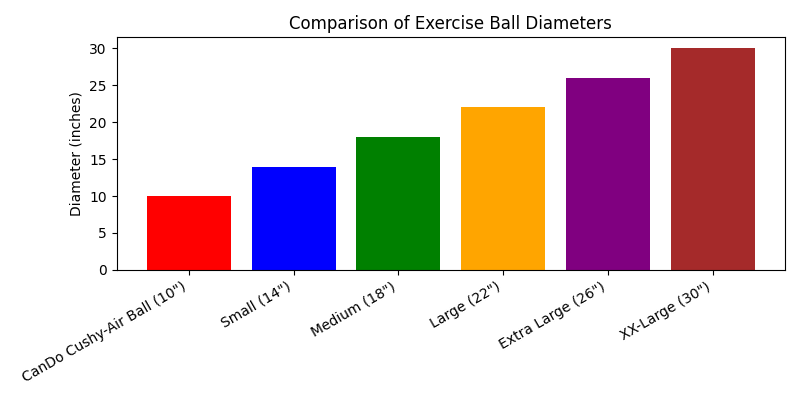
Figure 1 – The Cushy‑Air Ball’s 10‑inch diameter compared with typical exercise‑ball sizes. Standard stability balls begin at ~14 inches and are used for core and balance training.
Because the Cushy‑Air Ball is smaller and lighter than full‑size stability balls, it is easier to handle, more portable and well suited to patients recovering from injury or children with developing motor skills. For adults seeking core activation and balance improvement, larger exercise balls provide unstable surfaces that engage abdominal and back muscles. However, a small Cushy‑Air Ball can still be used under the hands or between the knees to add mild instability to exercises and train stabilizer muscles.
Benefits of unstable‑surface training
Research on exercising with unstable surfaces (such as Swiss balls) shows several benefits:
-
Increased muscle activation – performing exercises on an unstable surface causes the body to engage more muscles to maintain balance; this increases activation of core muscles including the rectum abdominis and back extensors.
-
Core strengthening – greater electromyographic (EMG) activity is observed during curl‑ups and push‑ups performed on a ball compared with a stable surface.
-
Trunk stability – unstable‑surface training helps develop trunk stabilizer strength, which can improve posture and reduce injury risk.
-
Versatility – a small inflatable ball can add instability to many traditional exercises (e.g., squats, bridges) without requiring the space of a large stability ball.
These benefits highlight why using a Cando Cushy‑Air Ball for rehabilitation exercises can enhance muscle engagement and coordination.
Color options & ordering information
| Color | SKU | UPC | Special notes | |||
|---|---|---|---|---|---|---|
| Red | EN‑301740R | 714905041371 | Soft, cushioned; easy‑to‑grasp | |||
| Green | EN‑301740G | 714905041388 | Designed for simple hand and grip exercises |
|||
| Yellow | EN‑301740Y | 714905041364 | Lightweight and easy to hold; can be deflated to adjust firmness |
**Each ball is sold individually. Customers often purchase multiple colors to designate different exercise stations or therapy levels. The balls are latex‑free and are shipped deflated for easy transport. To order, select the desired color and quantity and click Add to Cart.
Frequently asked questions (FAQs)
Q – How do I inflate the Cushy‑Air Ball?
A – Remove the valve stem, insert a standard inflator tip or pump and add air until the ball reaches its 10‑inch diameter. You can also blow air into the ball by mouth. Replace the valve stem firmly to maintain pressure. To soften the ball, release some air and check the firmness.
Q – Is the ball latex‑free?
A – Yes. The ball is made from vinyl and does not contain natural rubber latex, making it safe for people with latex allergies.
Q – Can children use this ball?
A – The ball’s soft texture and light weight make it suitable for children under adult supervision. It is often used in pediatric therapy for sensory stimulation and fine‑motor development.
Q – What exercises can I do with such a small ball?
A – Beyond hand squeezes, you can place the ball under the palm during planks to add instability, hold it between the knees during bridges or squats, or use it for stretching and mobility drills. Its small size lets you integrate it into Pilates or yoga routines.
Q – How does this ball differ from a standard stability ball?
A – A standard stability ball is much larger (14–37 inches in diameter) and is intended for sitting, core training and balance exercises. The Cushy‑Air Ball is only 10 inches and is primarily used for hand exercises, squeezing and adding small amounts of instability to workouts.
Q – Do the different colours indicate different resistance levels?
A – No. All colours are made from the same material and have the same weight and firmness when inflated. Colours allow users to choose a preferred appearance or to organize multiple balls in a clinic or classroom.
Conclusion
The Cando Cushy‑Air Ball is a versatile, compact exercise tool that provides gentle resistance for hand‑strengthening and rehabilitation exercises. Its soft vinyl surface is comfortable and easy to grip, while adjustable inflation lets users tailor the firmness to their needs. Although much smaller than traditional stability balls, it can be used to introduce mild instability into workouts, promoting greater muscle engagement and improving coordination. Available in red, green and yellow with distinct SKUs and UPCs, the Cushy‑Air Ball is an affordable addition to therapy clinics, classrooms or home exercise programs.