



 29th Apr 2026
 Posted by Lynn Perkes, MS, AT, PTA on
Dexterity & Manipulation Testing and Training: A Guide for Patients, Caregivers, and Clinicians
Fine motor skills are the unsung heroes of daily life. From buttoning a shirt to holding a pen, the ability to control the small muscles of the hands and fingers underpins nearly every task we perform. When those abilities are compromised — whether through injury, neurological condition, aging, or surgery — dexterity and manipulation testing and training become essential tools on the road to recovery and independence.
At ProHealth Care Products, we carry a wide range of assessment and rehabilitation tools designed to help clinicians evaluate hand function and help patients rebuild it. This guide walks through what dexterity and manipulation testing is, why it matters, how training works, and the leading products available today.
What Is Dexterity and Manipulation Testing?
Dexterity testing is the clinical assessment of a person's ability to control precise, coordinated movements of the fingers, hands, and sometimes the whole arm. Manipulation testing goes a step further, evaluating how well a person can handle, move, and place small objects — skills that are central to vocational tasks, self-care, and overall quality of life.
These assessments are used across a wide range of healthcare and vocational settings, including:
- Occupational therapy clinics and rehabilitation hospitals
- Physical therapy for post-surgical or post-injury hand recovery
- Neurological rehabilitation following stroke, Parkinson's disease, or multiple sclerosis
- Vocational rehabilitation programs assessing a worker's ability to return to job duties
- Pediatric therapy for children with developmental delays or conditions like cerebral palsy
- Pre-employment screening in industries requiring fine motor precision
The goal is always the same: to get an objective, measurable picture of where a person's hand function currently stands — and to track progress over time.
Why Is Dexterity and Manipulation Testing Important?
Standardized dexterity testing removes the guesswork. Rather than relying on a clinician's subjective observations alone, validated assessments produce scores that can be compared to normative data (established ranges from healthy populations), tracked across multiple therapy sessions, and used to guide treatment planning.
Here's why this matters in practice:
For patients, testing establishes a clear baseline and provides measurable evidence of improvement — a powerful motivator during long rehabilitation journeys.
For therapists, standardized scores allow for consistent documentation, facilitate communication between care team members, and support decisions about when a patient is ready to return to work or independent living.
For employers and vocational programs, dexterity benchmarks help determine whether a worker can safely and effectively perform job tasks — particularly in fields like assembly, manufacturing, healthcare, and food service.
For researchers and healthcare systems, validated tests provide consistent data that can be used to evaluate treatment effectiveness across large patient populations.
Leading Dexterity and Manipulation Assessment Products
Purdue Pegboard Test
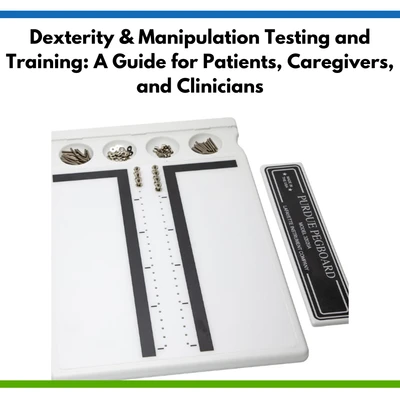
The Purdue Pegboard is one of the most widely used and extensively validated fine motor assessments in the world. Originally developed in the 1940s by Joseph Tiffin at Purdue University for vocational guidance and employee selection, it has since become a cornerstone tool in occupational therapy, neurological assessment, and rehabilitation medicine.
How it works: The Purdue Pegboard consists of a board with two parallel rows of small holes and four cups at the top holding pins, washers, and collars. The test is administered in four subtests:
- Right hand — the patient places as many pins as possible in the right row of holes in 30 seconds using only the right hand
- Left hand — same task using only the left hand
- Both hands — pins are placed simultaneously in both rows
- Assembly — a more complex bilateral task where the patient assembles pin, washer, collar, and washer combinations in sequence
Each subtest is typically performed three times and averaged. Scores are then compared against published normative data, with separate norms available for different age groups and occupational categories.
What it measures: The Purdue Pegboard assesses gross movements of the hands, fingers, and arms (in the pin placement subtests) as well as fingertip dexterity (in the assembly subtest). It is sensitive to impairments in both speed and coordination, making it valuable for detecting deficits following stroke, peripheral nerve injuries, hand trauma, Parkinson's disease, and other conditions affecting upper extremity function.
Why clinicians trust it: Decades of research have established strong reliability and validity for the Purdue Pegboard. It correlates well with real-world functional performance and is recognized by vocational rehabilitation bodies in the United States and internationally.
Grooved Pegboard Test
The Grooved Pegboard is another highly respected assessment tool, particularly popular in neuropsychological evaluations. Unlike the Purdue Pegboard's round-hole design, the Grooved Pegboard features 25 holes with randomly positioned slots, and each peg has a ridge that must be oriented to match the slot before insertion.
This added rotation component makes it significantly more demanding on visual-motor coordination and fine motor speed than simpler pegboard tests.
What it measures: The Grooved Pegboard is especially sensitive to conditions affecting the central nervous system — including multiple sclerosis, traumatic brain injury, Parkinson's disease, HIV-associated neurocognitive disorders, and age-related cognitive and motor decline. It is frequently used in research settings as well as clinical neuropsychology.
How it's scored: Time to completion is recorded for dominant and non-dominant hands separately. Number of drops is also noted. Normative data is available across a broad age range, from children to older adults.
Box and Block Test (BBT)
The Box and Block Test is a simple, quick, and widely used measure of unilateral gross manual dexterity. It requires minimal equipment — just a partitioned box and a set of 150 small colored cubes — and can be administered in under five minutes.
How it works: The patient is seated in front of the box. Using one hand at a time, they move as many blocks as possible from one compartment to the other over a 60-second period, picking up only one block at a time. The score is the number of blocks transferred.
Why it's popular: The BBT is easy to administer, non-threatening for patients, and appropriate across a wide age range. It has been validated for use with stroke survivors, patients with multiple sclerosis, individuals with cerebral palsy, and older adults. Because of its simplicity, it is also an excellent choice for serial testing — tracking function over multiple sessions without practice effects skewing results significantly.
Nine-Hole Peg Test (9-HPT)
The Nine-Hole Peg Test is a brief, standardized measure of finger dexterity. It consists of a shallow container holding nine pegs and a board with nine holes arranged in a 3×3 grid.
How it works: The patient picks up the pegs one at a time, places them in the holes as quickly as possible, then removes them one at a time and returns them to the container. Time to completion is recorded for each hand.
What it measures: The 9-HPT is widely used in multiple sclerosis research and clinical trials as a measure of upper extremity function. It is also used in stroke rehabilitation, hand therapy, and pediatric assessments. Its brevity makes it ideal for frequent repeated measurement, and it has excellent sensitivity to change over time.
Minnesota Rate of Manipulation Test (MRMT)
The Minnesota Rate of Manipulation Test evaluates the speed and dexterity of arm-hand movements involving larger components than pegboard tests. It uses a board with 60 round discs and assesses tasks including placing, turning, displacing, one-hand turning and placing, and two-hand turning and placing.
What it measures: The MRMT captures gross manual dexterity and arm-hand coordination rather than fingertip precision. This makes it particularly relevant for vocational assessments involving assembly line tasks, packing, sorting, and other work that demands rapid, coordinated arm movements.
JAMAR Hand Dynamometer & Pinch Gauge
While not pegboard-based, no dexterity assessment toolkit is complete without grip and pinch strength measurement. The JAMAR Hydraulic Hand Dynamometer is the gold standard for measuring isometric grip strength, while companion pinch gauges measure lateral (key), tip, and palmar (chuck) pinch strength.
Why it matters: Strength and dexterity are closely related. Grip and pinch strength scores provide important context for functional limitations and help therapists design targeted strengthening programs. The JAMAR is the most widely cited dynamometer in the rehabilitation literature and is considered the benchmark for clinical and research use.
Dexterity and Manipulation Training: Building Back What's Been Lost
Assessment is only the beginning. Once a baseline is established, the real work begins — retraining the hands and fingers to move with precision, speed, and coordination. Dexterity training programs typically involve a combination of specific exercises, therapeutic tools, and progressively challenging activities designed to stimulate neuroplasticity (the brain's ability to reorganize and form new connections).
Therapy Putty
Therapy putty is one of the most versatile and commonly recommended tools for hand rehabilitation. Available in a range of resistances (extra-soft through extra-firm), it can be used for dozens of exercises targeting grip strength, pinch strength, finger extension, and individual finger isolation.
Exercises with therapy putty include finger pinching, full-hand squeezing, thumb opposition, finger spreading, and intrinsic strengthening exercises that target the small muscles inside the hand itself.
Hand Exerciser Rings and Finger Exercisers
Resistance rings and spring-loaded finger exercisers provide graduated resistance for strengthening individual fingers and improving overall hand endurance. These are popular with musicians, typists, athletes, and rehabilitation patients alike.
Pegboard Training Sets
Pegboards are not only for assessment — they make excellent training tools as well. Repeated practice with peg placement exercises challenges visual-motor integration, fine motor speed, and bilateral coordination. Many occupational therapists use the same pegboards for both evaluation and as part of their daily therapy activities.
Fine Motor Activity Kits
Commercial fine motor kits typically include a variety of small objects — beads, coins, buttons, clothespins, and similar items — that patients practice manipulating in structured activities. These kits simulate real-world dexterity demands and are useful across a wide age range, from pediatric patients working on developmental skills to older adults maintaining independence in daily tasks.
Adaptive and Assistive Training Tools
For patients working to regain functional independence, training with adaptive equipment — such as built-up handle utensils, button hooks, and key turners — serves double duty: it builds dexterity while simultaneously enabling participation in daily activities. This approach, central to occupational therapy practice, ensures that training is always connected to meaningful, real-world goals.
The Benefits of Dexterity Testing and Training
The evidence base for structured dexterity assessment and training is robust. Here is a summary of the key benefits supported by research and clinical practice:
Objective measurement of function. Standardized tests produce reproducible scores that quantify exactly where a patient stands — removing ambiguity and enabling precise tracking of progress.
Earlier identification of deficits. Regular dexterity screening can detect subtle changes in hand function that might otherwise go unnoticed until they significantly impact daily life — particularly important in progressive neurological conditions like Parkinson's disease and multiple sclerosis.
Personalized treatment planning. Knowing precisely which aspects of dexterity are impaired — gross coordination versus fine fingertip control, dominant versus non-dominant hand, speed versus accuracy — allows therapists to tailor interventions rather than taking a one-size-fits-all approach.
Documented functional improvement. For patients navigating insurance approvals and return-to-work determinations, objective test scores provide the documentation needed to demonstrate progress and justify continued therapy.
Neuroplasticity and functional recovery. Research consistently shows that targeted, repetitive practice of fine motor tasks stimulates neuroplastic changes in the brain and peripheral nervous system — meaning that dedicated dexterity training can produce genuine, lasting improvements in hand function, even after significant injury or neurological damage.
Improved quality of life and independence. Ultimately, better hand function translates directly to greater independence in activities of daily living, improved confidence, and a higher quality of life — the outcomes that matter most to patients and their families.
Choosing the Right Products for Your Needs
Selecting the appropriate assessment and training tools depends on several factors: the patient population being served, the clinical setting, the specific conditions being addressed, and the goals of the program. A few general guidelines:
For broad clinical or vocational assessment, the Purdue Pegboard and Minnesota Rate of Manipulation Test provide comprehensive coverage of both fine and gross manual dexterity.
For neurological and neuropsychological evaluation, the Grooved Pegboard and Nine-Hole Peg Test offer high sensitivity to central nervous system involvement.
For quick, serial monitoring, the Box and Block Test and Nine-Hole Peg Test are efficient choices that minimize administration burden.
For home exercise programs, therapy putty sets, finger exercisers, and simple peg training boards give patients effective tools they can use independently between therapy sessions.
Conclusion
Dexterity and manipulation testing and training represent some of the most clinically powerful tools available in occupational and physical therapy. Whether the goal is a precise vocational assessment, guiding a post-stroke rehabilitation program, or helping an older adult maintain the hand function needed to live independently, the right assessment tools and training products make a measurable difference.
At Pro HealthCare Products, we are committed to stocking the professional-grade assessment tools and rehabilitation products that clinicians trust and patients depend on. From the classic Purdue Pegboard to therapy putty and beyond, our catalog is designed to support every stage of the hand function journey — from initial evaluation through full functional recovery.
Browse our full selection of dexterity assessment and hand therapy products today.
This article is intended for informational purposes and does not constitute medical advice. Always consult a licensed healthcare professional for individualized assessment and treatment recommendations.