



 11th Nov 2026
 Posted by Lynn R. Perkes, MS, AT, PTA on
Strength and Evaluation Testing: A Buyer’s Guide for Clinics, Universities and Researchers
PROHEALTHCAREPRODUCTS.COM • BUYER’S GUIDE
Strength and Evaluation Testing: A Buyer’s Guide for Clinics, Universities and Researchers
A practical guide to choosing objective strength and functional evaluation equipment for clinical practice, education and research.
Why objective strength measurement matters
Strength is one of the most useful numbers in rehabilitation, sports science and occupational health, and it is only useful if you can measure it the same way twice. Manual muscle testing (the familiar 0-to-5 scale) is quick, but it depends heavily on the examiner and struggles to tell a 4 from a 5. A calibrated dynamometer turns “feels stronger” into pounds, kilograms or newtons that can be charted, compared to norms and defended in a report.
That matters to three groups in different ways:
- Clinics need fast, repeatable tests that document progress for patients, physicians and payers.
- Universities need durable, easy-to-learn devices for teaching labs, plus instruments students will meet again in practice.
- Researchers need instruments with published reliability and validity, consistent calibration, and clean data export.
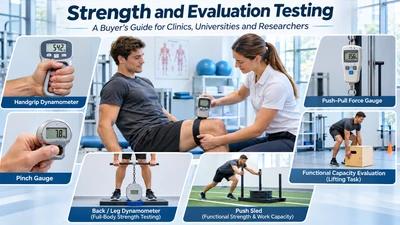
This guide walks through each family of strength and evaluation equipment we carry at ProHealthcareProducts.com: back, leg and chest dynamometers, handgrip dynamometers, handheld dynamometers, push-pull dynamometers, pinch gauges and functional capacity evaluation (FCE) equipment. Each section covers what the tool measures, where it fits, and what to look for when buying. Deeper guides on each category will follow.
What to look for in any strength testing device
Whatever you are measuring, the same five questions separate a good purchase from an expensive paperweight.
- Reliability. Does the device give the same reading when the same person is tested twice? Look for published test-retest and inter-rater reliability, usually reported as an ICC (intraclass correlation coefficient, where values closer to 1.0 mean more consistent results).
- Validity and norms. Has the device, or the method it uses, been compared against a reference standard, and are there normative data for your population? Norms let you say a result is low for age and sex, not just low.
- Calibration. Every dynamometer drifts over time. Ask how it is calibrated, whether a certificate is included, and how often the manufacturer recommends rechecking. Research protocols often require documented calibration before data collection.
- Hydraulic, mechanical or digital. Hydraulic and mechanical gauges are simple, durable and need no batteries. Digital units add peak hold, averaging, unit switching and, on many models, software for storing and exporting results.
- Data handling. For clinics, that means fast documentation. For researchers, it means raw data export, timestamps and, ideally, force-time curves rather than a single peak number.
A useful rule of thumb: choose the device your reference studies used. If your normative data came from a specific instrument and protocol, matching both keeps your comparisons honest.
Back, leg and chest dynamometers
Back, leg and chest dynamometers measure large-muscle-group strength: the force a person can produce in a standardized lift, leg press or chest squeeze. They are the classic tools of exercise physiology and fitness testing labs.
How they work. A back and leg dynamometer typically uses a platform the subject stands on and a handle connected by a chain. The subject pulls upward with a fixed body position, and a gauge records peak force. Chest dynamometers are squeezed or pulled between the hands at chest height to assess upper-body pushing and pulling strength.
Where they fit.
- Universities use them in kinesiology and exercise science labs to teach strength assessment and compare groups.
- Researchers use them in fitness surveys, athletic profiling and studies of trunk and lower-limb strength.
- Clinics and occupational health programs use them for baseline screening, though protocols must be chosen carefully for patients with back pain.
Buying considerations. Look at maximum capacity (strong athletes can exceed lighter-duty models), adjustable chain length for different heights, a stable platform, and whether you want an analog gauge or a digital readout with peak hold. Safety and a clear, standardized posture matter more here than with any other device in this guide.
Browse the category: Back, Legs and Chest Dynamometers.
Handgrip dynamometers
Handgrip dynamometers are the most widely used strength test in healthcare, and for good reason: a grip test takes about a minute and says a surprising amount about overall health.
Why grip strength matters beyond the hand. Large population studies, including the multinational PURE study published in The Lancet in 2015, have linked low grip strength to higher risk of death and cardiovascular disease. Grip strength is also a core screening measure for sarcopenia (age-related loss of muscle); the European EWGSOP2 consensus uses cut-offs of under 27 kg for men and under 16 kg for women. That makes grip a common outcome measure in geriatrics, nutrition, oncology and chronic disease research, not just hand therapy.
The standard protocol. The American Society of Hand Therapists (ASHT) protocol is the most common reference: seated, shoulder adducted, elbow at 90 degrees, forearm neutral, handle in the second position, with the mean of three trials recorded. Using the same protocol as your normative data is essential.
Main types.
- Hydraulic (the Jamar-style design and Baseline hydraulic models): the long-standing clinical reference, durable and battery-free, with an adjustable five-position handle.
- Digital (for example Baseline BIMS digital models and the Hoggan MicroFET HandGrip): add peak hold, automatic averaging, and on some models software for storing results and exporting data.
- Pneumatic or bulb styles: useful for patients with arthritis or very weak grip, where a rigid handle is painful or impractical.
Buying considerations. Clinics usually want durability and fast documentation. Research teams should favor models with published reliability, calibration certificates and data export. A five-position handle is standard for full hand evaluations, including the five-position test for sincerity of effort.
Browse the category: Handgrip Dynamometers.
Handheld dynamometers
Handheld dynamometers (HHDs) bring numbers to manual muscle testing. The examiner holds a small force sensor against the limb while the patient pushes, and the device records peak force for an individual muscle group: hip abductors, knee extensors, shoulder rotators and so on.
Why they are popular. Isokinetic machines are the lab gold standard, but they are large, costly and fixed in place. HHDs cost a fraction as much, fit in a bag, and studies show good reliability when testers use standardized positions. That makes them a practical middle ground for clinics, sideline sports medicine, home health and multi-site research.
Getting reliable results. The weak link is usually the tester, not the sensor. A strong patient can overpower a smaller examiner, especially for knee extension or hip extension. Common fixes include using a belt or strap to stabilize the device (belt-stabilized testing), standardized limb positions, and recording the mean of several trials. Many devices support both “make” tests (patient pushes into a fixed device) and “break” tests (examiner overcomes the patient).
Buying considerations. Look for wireless data transfer, interchangeable pads for different body parts, software that calculates side-to-side differences, and published reliability data. The Hoggan MicroFET 2 is a common choice in both clinics and published research.
Browse the category: Handheld Dynamometers.
Push-pull dynamometers
Push-pull dynamometers (often called force gauges) measure how much force it takes to push or pull something. Where a handheld dynamometer measures the person, a push-pull gauge often measures the task.
Common uses.
- Ergonomics and job analysis: measuring the force needed to push a cart, open a door, pull a lever or slide a load. These numbers feed into job descriptions, return-to-work decisions and workplace redesign.
- Strength testing: with the right attachments, assessing pushing and pulling strength of the upper body or specific muscle groups.
- Research: quantifying task demands in occupational biomechanics and human factors studies.
How they differ from handheld dynamometers. Push-pull gauges typically come with a set of hooks, flat and concave tips and extension rods, and they are built to read both compression (push) and tension (pull). Many show peak force and real-time force, which helps separate the initial force to get an object moving from the sustained force to keep it moving.
Buying considerations. Match capacity to the job: light-duty gauges suit fine motor and small-joint testing, while workplace assessments may need much higher ranges. Check the attachment kit, resolution, unit options and whether readings can be logged.
Browse the category: Push-Pull Dynamometers.
Pinch gauges
Pinch gauges measure the strength of the thumb and fingers, the small-but-mighty muscles behind buttoning a shirt, turning a key or holding a pen. Grip tells you about the whole hand; pinch tells you about precision.
The three standard pinches.
Where they fit. Hand therapists use pinch strength after tendon repairs, nerve injuries, fractures and thumb arthritis. Researchers use it in studies of carpal tunnel syndrome, rheumatoid arthritis, stroke and neuromuscular disease. Universities use pinch gauges alongside grip dynamometers to teach complete hand evaluations.
Buying considerations. Choose a capacity that fits your population: standard gauges suit most adults, while lower-range gauges give better resolution for pediatric, geriatric or neurologically impaired patients. Hydraulic and mechanical gauges are durable classics; digital gauges add peak hold and data storage. Hand evaluation sets that bundle a grip dynamometer and pinch gauge are popular for clinics and teaching labs.
Browse the category: Pinch Gauges.
Functional capacity evaluation (FCE) equipment
A functional capacity evaluation measures what a person can safely do at work: how much they can lift, carry, push, pull and handle, and for how long. Where the other tools in this guide measure strength in isolation, FCE equipment measures strength in action.
Who uses FCEs. Occupational and physical therapists perform FCEs for return-to-work decisions, workers’ compensation and disability claims, pre-employment screening and work hardening programs (structured rehab that rebuilds job-specific capacity). Because results can carry legal and financial weight, standardized equipment and documented methods are essential.
Typical equipment.
- Lifting boxes and crates with handles and graduated weights, for floor-to-waist, waist-to-shoulder and carrying tests.
- Sleds for measuring pushing and pulling capacity over a set distance.
- Work devices and simulators such as shelving units, lifting stations and assembly tasks that mimic real job demands.
- Supporting tools from earlier in this guide: grip dynamometers, pinch gauges and push-pull gauges all appear in most FCE protocols. Grip testing at multiple handle positions is often used to help judge consistency of effort.
For universities and researchers. FCE equipment supports teaching in OT and PT programs and research on occupational injury, ergonomics and return-to-work outcomes.
Buying considerations. Look for durable construction, clearly marked weight increments, handle heights that match common protocols, and compatibility with the FCE system or method your clinic follows.
Matching the tool to your setting
Most buyers do not need every device. This quick reference shows what each tool measures and where it earns its keep.
Starter suggestions. A general outpatient clinic is well served by a grip dynamometer, a pinch gauge and a handheld dynamometer. A teaching lab often adds a back and leg dynamometer. An occupational health program builds on those with a push-pull gauge and FCE equipment.Building your strength testing toolkitObjective strength testing turns patient progress, student learning and research findings into numbers you can trust. The right toolkit depends on your questions: grip and pinch for the hand, handheld dynamometers for individual muscles, back and leg dynamometers for whole-body strength, push-pull gauges for task demands, and FCE equipment to put it all together in a work context.ProHealthcareProducts.com carries trusted brands across all six categories, including Baseline, Jamar, Hoggan MicroFET and JTech. Buying for a university, hospital or research grant? We accept , offer , and provide discounts on bulk orders. Call us at 801-770-3328 or email service@prohealthcareproducts.com.Coming next in this series: in-depth guides to each category, covering models, protocols, normative data and buying tips.Back, leg and chest dynamometersHandgrip dynamometersHandheld dynamometersPush-pull dynamometersPinch gauges- Functional capacity evaluation equipment