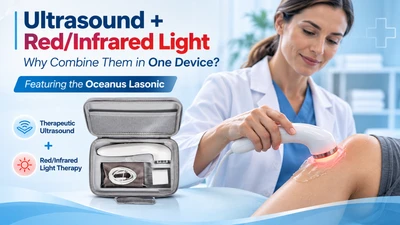
Ultrasound + Red/Infrared Light: Why Combine Them in One Device?
Therapeutic ultrasound and red/near-infrared light therapy work on tissue in different ways: ultrasound delivers mechanical and thermal energy, while light acts on cells' energy machinery. Putting both in one handheld device lets you apply two complementary treatments to the same sore spot in one session.
This article explains how each modality works, why clinicians and researchers think they may work well together, and what the research actually shows so far. It closes with a look at the Oceanus Lasonic (OCEETUS003), a portable unit that combines 1 MHz ultrasound with 810 nm infrared and 610 nm red light, and tips for using it well.
How each modality works
Therapeutic ultrasound: mechanical and thermal energy
Ultrasound sends high-frequency sound waves through gel into soft tissue. At 1 MHz the energy is absorbed mostly in deeper tissue such as muscle, joint capsule and tendon.
Continuous ultrasound warms tissue, increasing local blood flow and making collagen-rich structures (scar, joint capsule, tendon) easier to stretch.
Pulsed ultrasound limits heat and emphasizes mechanical effects, gentle micro-motion in and around cells that is thought to support tissue repair.
In practice the two effects overlap, since even low-intensity ultrasound produces some heat and some mechanical force (Am J Phys Med Rehabil review).
Red and near-infrared light: photobiomodulation
Photobiomodulation (PBM), also called low-level laser or light therapy (LLLT), uses low-power red and near-infrared light to promote tissue repair, reduce inflammation and relieve pain. Unlike surgical lasers, it does not cut or meaningfully heat tissue (de Freitas & Hamblin, 2016).
The leading explanation: light is absorbed by cytochrome c oxidase, an enzyme in the mitochondria (the cell's "power plants"). This is thought to boost the cell's energy production (ATP) and trigger signals linked to tissue repair and reduced inflammation (Hamblin, 2017).
Wavelength matters: red light (around 610–660 nm) is absorbed closer to the surface; near-infrared light (around 780–860 nm) reaches deeper. Wavelengths between roughly 700 and 780 nm are less effective (de Freitas & Hamblin, 2016).
Dose matters even more: benefit depends on delivering enough light energy, measured in joules, to each treatment spot. Too little has no effect, and very high doses can blunt the response.
Science still in progress: the exact mechanism is still debated, and some researchers question how much the cytochrome c oxidase theory explains (Photobiomodul Photomed Laser Surg, 2020).
Why combine them?
The case for combining rests on one idea: the two modalities act through different pathways, so together they may address more of what goes on in an injured or painful tissue than either one alone.
Therapeutic ultrasound
Red / near-infrared light (PBM)
Energy type
Mechanical sound waves
Light (photons)
Main target
Tissue as a whole: collagen, fluid, blood flow
Cells: mitochondria and cell signaling
Main effects
Deep warming, improved tissue extensibility, mechanical stimulation of repair
Red is more superficial; near-infrared reaches deeper
The proposed advantages of a combined device
Two mechanisms, one session. Ultrasound addresses tissue stiffness and blood flow, while light targets inflammation and cell activity in the same area.
Multiple depths. Red light, near-infrared light and 1 MHz ultrasound each concentrate their effects at different tissue depths.
Convenience and cost. One handpiece, one battery, one session time instead of two devices and two treatment slots.
Better fit for home care. Fewer devices make a home program easier to follow consistently.
These advantages are logical and biologically plausible. Whether combining them produces a meaningfully bigger result than either one alone is a separate question, and that is where the research comes in.
What the evidence says
Each modality has its own body of research, and light therapy's is the stronger of the two for pain. Studies of the combination are few and small: they are encouraging, but they do not yet prove the combination beats either therapy alone.
Light therapy (PBM) on its own
Knee osteoarthritis: a meta-analysis of 22 placebo-controlled trials (1,063 participants) found light therapy reduced pain and disability, with the clearest benefit at recommended doses: 4–8 joules per treatment spot at 785–860 nm (Stausholm et al., BMJ Open 2019).
Shoulder tendinopathy: a meta-analysis of 17 trials found clinically relevant pain relief both alone and alongside exercise, while trials using too little energy showed no effect (Haslerud et al., 2015).
Tendinopathy in general: an earlier review found positive results when recommended doses were used and inconclusive results overall (Tumilty et al., 2010).
The common thread: light therapy works best when enough energy reaches the tissue.
Ultrasound on its own
The research is mixed. Recent reviews support pain relief for knee conditions, with weaker or mixed results elsewhere (Guan et al., 2024).
Ultrasound and light combined
Study
Condition
Design
What it found
Paolillo et al., Rheumatol Int 2018
Knee osteoarthritis (women)
Randomized, placebo-controlled; 35 completed
Combined device improved pain thresholds and sit-to-stand performance more than placebo after 3 months, with or without exercise. No ultrasound-only or light-only arm.
Asadi et al., 2021
Carpal tunnel syndrome
Randomized; 45 patients; combined vs. ultrasound alone vs. laser alone
All three groups improved in pain, grip and function. The combined group improved slightly more, but the difference was not statistically significant.
Growing pains pilot, J Biophotonics 2026
Growing pains (children 4–12)
Randomized pilot vs. placebo
Combined treatment appeared safe with possible benefit; authors call for larger trials.
Evidence takeaway:Bottom line: the combined approach has solid reasoning, two individually useful modalities, and early studies showing benefit over placebo. The most reasonable claim today is that a combined device offers two evidence-supported treatments in one convenient session.
The Oceanus Lasonic (OCEETUS003): both modalities in one handpiece
The Lasonic puts 1 MHz ultrasound and dual-wavelength light therapy into a cordless handheld unit. The ultrasound can run on its own or together with the light, so one device covers both approaches described above (Oceanus; product page).
Specification
Oceanus Lasonic
Ultrasound frequency
1 MHz (deeper tissue)
Ultrasound output
0.5–5 W; maximum 1.25 W/cm²
Radiating area
4 cm²
Duty cycle
10%–100% in 10% steps (pulsed to continuous)
Light wavelengths
810 nm near-infrared + 610 nm red
Light power
5 mW, continuous
Treatment timer
1–30 minutes
Power
Rechargeable battery, about 8 hours of use; 1-hour charge
Included
8 oz bottle of ultrasound gel, carrying case
How it reflects the reasoning
810 nm sits in the near-infrared band used in the knee osteoarthritis research (785–860 nm), aimed at deeper tissue.
610 nm red light targets more superficial tissue.
Adjustable duty cycle lets you choose warming (continuous) or gentler, more mechanical (pulsed) ultrasound.
Cordless operation makes it practical for home programs, mobile clinicians and athletic trainers.
A note on light dose
The Lasonic's light output is 5 mW. Energy builds with time: 5 mW for 10 minutes delivers about 3 joules. So, the light component works as a gentle complement to the ultrasound, and longer sessions over a focused area deliver more of it. Ultrasound remains the device's primary therapy.
Using a combined device well and safely
Getting the most from each session
Treat a focused area about twice the size of the sound head rather than sweeping a whole limb.
Use plenty of gel and keep the head flat and moving slowly on the skin.
Choose continuous ultrasound for stiffness and chronic tightness; choose pulsed settings for more recent or sensitive injuries.
Give the light time to work: longer sessions on one spot deliver more light energy.
Pair treatment with the stretching and strengthening your provider recommends. Both modalities showed their best results as part of active care.
Light safety
Never look directly into the light emitter or point it at anyone's eyes.
Keep the head in contact with the skin while the light is on.
Do not use (or ask your provider first):
Over the abdomen or low back during pregnancy
Over a known or suspected cancer
Over the growth plates of children and teens, unless directed by a clinician
Over infected tissue, open wounds or a suspected blood clot
Over the eyes, the heart or an implanted device such as a pacemaker
On skin with reduced sensation or over metal implants without professional guidance
With light-sensitizing medications, without checking with your provider
Follow the instructions in the Lasonic user manual and your healthcare provider's plan.
Frequently asked questions
Is red light therapy the same as ultrasound? No. Ultrasound uses sound waves that warm and mechanically stimulate tissue; red and near-infrared light acts on cells' energy machinery without meaningful heat.
Does combining them work better than one alone? It may. The reasoning is sound and early studies are positive, but large trials comparing the combination to each therapy alone are still needed.
What conditions are a combined device used for? Common uses include tendinitis, bursitis, muscle strains, ligament sprains, plantar fasciitis, arthritis-related joint pain and joint stiffness.
How long is a session? Typical sessions run about 5–20 minutes per area, and the Lasonic allows up to 30 minutes.
Can I use it at home? Yes. The Lasonic is battery-powered and designed for at-home and mobile use. Work with your healthcare provider on where, how often and at what settings to treat.
Explore dual-therapy devices
If you want ultrasound and light therapy in one portable unit, the Oceanus Lasonic brings both into a single handpiece. ProHealthcareProducts.com also carries the ultrasound-only Oceanus Pulsonic and the ultrasound + TENS Oceanus Stimsonic, plus gel and accessories. Questions? Call 801-770-3328 or email service@prohealthcareproducts.com.
de Freitas LF, Hamblin MR. Proposed mechanisms of photobiomodulation or low-level light therapy. 2016. Link
Hamblin MR. Mechanisms and applications of the anti-inflammatory effects of photobiomodulation. 2017. Link
What lies at the heart of photobiomodulation. Photobiomodul Photomed Laser Surg. 2020. Link
Stausholm MB, et al. Efficacy of low-level laser therapy on pain and disability in knee osteoarthritis. BMJ Open. 2019. Link
Haslerud S, et al. The efficacy of low-level laser therapy for shoulder tendinopathy. Physiother Res Int. 2015. Link
Tumilty S, et al. Low level laser treatment of tendinopathy. Photomed Laser Surg. 2010. Link
Guan H, et al. Ultrasound therapy for pain reduction in musculoskeletal disorders. 2024. Link
Robertson VJ, Baker KG. A review of therapeutic ultrasound: effectiveness studies. Phys Ther. 2001. Link
Therapeutic ultrasound and shockwave therapy for tendinopathy: a narrative review. Am J Phys Med Rehabil. 2022. Link
Paolillo FR, et al. Ultrasound plus low-level laser therapy for knee osteoarthritis rehabilitation. Rheumatol Int. 2018. Link
Asadi MR, et al. Effect of low-level laser therapy combined with therapeutic ultrasound on carpal tunnel syndrome. Middle East J Rehabil Health Stud. 2021. Link
Combined low-level laser and ultrasound therapy for growing pains in children: a pilot study. J Biophotonics. 2026. Link




 10th Nov 2026
 Posted by Lynn Perkes, MS, AT, PTA on