



 8th Jul 2026
 Posted by Lynn Perkes, MS, AT, PTA on
At-Home Therapeutic Ultrasound Machines: A Comparative Review of The Leading Devices
At-Home Therapeutic Ultrasound Machines: A Comparative Review of The Leading Devices
Why ultrasound therapy works
Therapeutic ultrasound is one of the most widely used interventions among clinicians and physical therapists for musculoskeletal pain and injury. It works by generating gentle deep-tissue heat, which increases local blood flow and helps deliver oxygen and nutrients to healing tissue.
The rise of at-home treatment
Musculoskeletal conditions affect an estimated 1.71 billion people worldwide and are the single largest contributor to disability globally (WHO). As more people take an active role in managing these conditions themselves, at-home therapeutic ultrasound has become a top choice for self-directed care — treating symptoms and supporting the body’s natural healing process alongside, or between, clinical visits.
This mirrors a broader shift in healthcare. The U.S. home healthcare market is projected to grow at a 10% compound annual rate through 2033 (Grand View Research), and Medicare has kept pace: since 2022, CMS has reimbursed clinicians for remotely monitoring musculoskeletal therapy that patients perform at home, formal recognition that meaningful treatment increasingly happens outside the clinic.
Home units vs. clinical units
Portable, at-home therapeutic ultrasound units don’t come with all the bells and whistles of professional clinic machines, only offer an acoustic frequency of 1 MHz (soundwaves primarily absorbed in the deeper tissues), and they aren’t built for the heavy, multiple-session daily use of a clinical device. However, consider these important clarifications:
- Output Power: Duration of treatment can offset lower voltage. Performing the treatment for a longer period of time yields more total energy being delivered to the tissues over time. Thus, the lower wattage (e.g., 5W) means you may need longer treatment times when compared to a higher wattage (e.g., 10W).
- Duty cycle effects regardless of wattage: The duty cycle (continuous vs. pulsed) lets you dial between thermal effects (continuous, for heating/pain relief) and non-thermal effects (pulsed, for swelling/tissue repair) regardless of wattage.
- Tissue depth penetration: While 1 MHz frequency typically is used to target deeper tissues (3cm to 5cm depth), it does raise temperature in superficial tissues, but is less efficient for that purpose.
Consequently, portable at-home therapeutic ultrasound units within their intended use, deliver genuine, evidence-backed therapeutic benefit for a variety of musculoskeletal conditions.
The Top Contenders
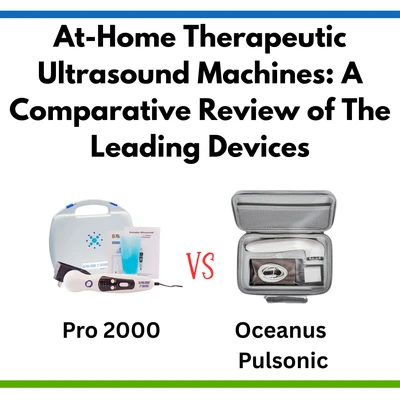
Two of the top at-home therapeutic ultrasound units are the Current Solutions US Pro 2000 and the Oceanus Pulsonic. Both are high-quality devices manufactured by established companies: Richmar/Compass Health Brands, maker of the US Pro 2000, and Oceanus America, maker of the Pulsonic.
Below is a side-by-side comparison of their specifications.
| Specification | Current Solutions US Pro 2000 | Oceanus Pulsonic |
|---|---|---|
| Acoustic Frequency | 1.0 MHz | 1.0 MHz |
| Output Power | Low 0.32W / Med 3.2W / High 6.4W (±20%) | 0.05–5.0W, continuously adjustable |
| Effective Radiating Area (ERA) | 4.0 cm² ±20% | 4.0 cm² ±10% |
| Max Intensity | ≈1.6 W/cm² ±20% (6.4W ÷ 4cm²) | 1.25 W/cm² |
| Waveform / Duty Cycle | Continuous (100%) + Pulsed | Pulsed + Continuous (10%–100% in 10% steps) |
| Pulse Mode/Mode | Not specified | 16 Hz |
| Treatment Timer | 3 presets: 5, 10, 15 min. | Adjustable: 1–30 min. |
| Applicator Head Preheat Feature | Yes – warms to 95°F, max 3 min | Not Offered |
| Applicator Material | Aluminum alloy, collimated beam | Not specified |
| Power Source | Corded AC/DC Adapter | Rechargeable Lithium-ion, 8-Hr Use, 1-Hr Charge Time |
| Display | LCD | LCD |
| Probe dimensions | 7.95 × 1.93 × 2.76 in | Not Published |
| Warranty | 1 year manufacturer’s Warranty | 1 year manufacturer’s Warranty |
| Watertight Applicator Head | Yes – can be used under water (Applicator head only – 1 cm depth) or with ultrasound gel | No |
Prohealthcareproducts.com offers both the US Pro 2000 (CS-DU3035) and the Oceanus Pulsonic (OCEETUS002) portable, at-home ultrasound machines. This article is intended to help you decide which device is best for you.
References
- Draper DO, Castel JC, Castel D. Rate of temperature increase in human muscle during 1 MHz and 3 MHz continuous ultrasound. J Orthop Sports Phys Ther. 1995;22(4):142-150.
- Knight KL, Draper DO. Therapeutic Modalities: The Art and Science. 2nd ed. Lippincott Williams & Wilkins; 2012.