



 27th Jul 2026
 Posted by Lynn Perkes MS,AT, PTA on
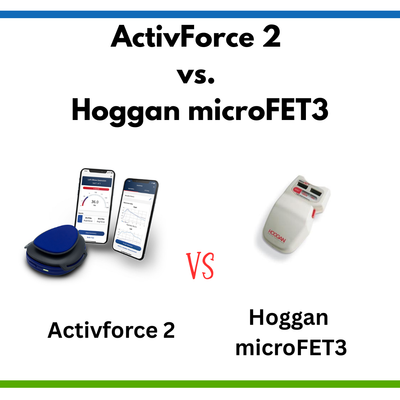
ActivForce 2 vs. Hoggan microFET3
ActivForce 2 vs. Hoggan MicroFET3
Choosing a Handheld Dynamometer and ROM Device for Clinical Practice
Handheld dynamometry has replaced manual muscle testing (MMT) as the objective standard for strength assessment in physical therapy, orthopedics, and sports medicine — MMT's ordinal 0-5 grading scale is too coarse to detect the strength changes that matter clinically, especially in mid-to-high function patients. Two devices dominate the clinic-grade market: the ActivForce 2 (ActivBody) and the Hoggan MicroFET3. Both combine a force dynamometer with a built-in inclinometer for range-of-motion (ROM) testing, but they take different approaches to accuracy, workflow, and cost.
Force Testing Capability
The ActivForce 2 measures a wider working range — up to 200 lb (90 kg), with a 250 lb max load — versus the microFET3's 0–150 lb range. Its accuracy is rated at ±(1.4 lb + 5% of the applied force), a spec that scales with load. The MicroFET3 counters with a flat ±1% of reading accuracy and dual threshold settings (a 0.8 lb low threshold for fine testing, a 3 lb high threshold for gross strength), letting clinicians dial in sensitivity by patient population. For raw dynamic range, ActivForce 2 has the edge; for stated precision consistency across the range, MicroFET3's flat percentage spec is easier to reason about clinically.
Range of Motion Testing
Both devices double as inclinometers, but ActivForce 2's 0–360° range covers full rotational movement in one placement, where the MicroFET3 is limited to 0–180°. Stated ROM accuracy is comparable (±1° for microFET3; the greater of ±3% or ±1° for ActivForce 2), so day-to-day reliability should feel similar in the exam room, but ActivForce 2 needs fewer repositions for movements that cross 180°.
Connectivity, Software, and Workflow
This is where the two devices diverge most. The MicroFET3 is a standalone unit with an onboard LCD — it displays peak force, elapsed time, and degrees with no phone, tablet, or subscription required. Pairing it to Hoggan's optional MicroFET or FET Data Collection software (each an added $662) unlocks trend reports and CSV export, but the device itself works independently out of the box. The ActivForce 2 is app-dependent: it has no onboard display and connects via Bluetooth to a free iOS/Android app with a library of 500+ guided tests, live force visualization, and cloud-based progress tracking. That app is included at no extra cost, but it does mean a phone or tablet is part of every test.
Physical Design and Portability
ActivForce 2 is dramatically lighter and more pocketable — 4.8 oz versus roughly 4 lb for the MicroFET3 kit — and runs on a single AAA battery rather than a rechargeable lithium-ion cell. For clinicians moving between treatment rooms or doing home visits, that difference is noticeable by the end of a shift.
Price and Value
At $500, ActivForce 2 undercuts the MicroFET3's $1,659 base price by a wide margin, and its core app is bundled in at no extra cost. When additional options are added to MicroFET3’s base price, the price increases accordingly:
- With Clinical Software and Bluetooth stick: $2850.40
- Combination with data collection software: $2,254.60
- Combination with clinic and data collection software: $2,739.60
Bottom Line
Choose the ActivForce 2 for a lightweight, app-driven system with a large built-in test library, full 360° ROM capability, and a lower up-front cost — ideal for clinics already comfortable pairing devices to a phone or tablet. Choose the MicroFET3 for a standalone, no-app-required device with tighter relative force accuracy, dual-threshold sensitivity, and an established track record in research and clinical settings — a better fit where independence from mobile hardware, or software-free bedside use, is a priority.
Sources: activforce.com/products/activforce-2 and hogganscientific.com/product/microfet3-digital-dynamometer-and-inclinometer (manufacturer specification pages, accessed July 2026). Specifications and pricing are subject to change.