



 10th Nov 2026
 Posted by Lynn Perkes, MS, AT, PTA on
Therapeutic Ultrasound Machines: Home, Clinic & Combo Units Explained
Therapeutic Modalities • Buying Guide
Therapeutic ultrasound comes in three main forms: compact units for home use, clinic-grade machines, and clinic-grade combination units that pair ultrasound with electrical stimulation or light therapy. Each form fits the needs of a different person, setting and treatment plan, so this guide explains what each one does rather than ranking them against each other.
Musculoskeletal conditions are the leading cause of disability worldwide, and ultrasound remains one of the most familiar tools physical therapists, athletic trainers and chiropractors use to manage them. Below you will find how therapeutic ultrasound works, which conditions it is used for, what the research says, and a profile of each of the six ultrasound devices we carry, with specifications taken from the manufacturers.
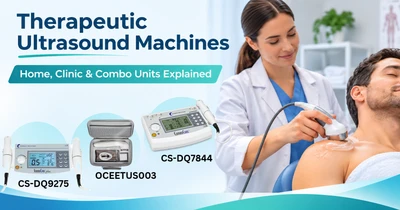
The six devices covered
- At-home portable: Current Solutions US Pro 2000 (CS-DU3035) and Oceanus Lasonic (OCEETUS003)
- Clinic-based ultrasound: Current Solutions SoundCare Plus (CS-DQ9275) and Chattanooga Intelect Transport 2 Ultrasound (CT-4782)
- Clinic combination units: Current Solutions ComboCare (CS-DQ7844) and Chattanooga Intelect Transport 2 Combo (CT-4738)
How therapeutic ultrasound works
Therapeutic ultrasound sends high-frequency sound waves from a metal applicator (the "sound head") through a layer of gel into soft tissue. The tissue absorbs that acoustic energy, which produces two kinds of effects that clinicians aim for on purpose.
- Thermal (heating) effects. Continuous ultrasound gently warms deeper tissue. Warm tissue gets more blood flow, stretches more easily and is often less painful, which is why clinicians commonly use it before stretching or joint mobilization.
- Non-thermal (mechanical) effects. Pulsed ultrasound delivers energy in short bursts, so less heat builds up. The mechanical activity in the tissue (called cavitation and acoustic streaming) is thought to support cell activity involved in tissue repair, which is why pulsed settings are often chosen to assist healing in more recent injuries.
Researchers note that in practice the two effects overlap, since even low-intensity ultrasound produces some heat and some mechanical force at the same time (Am J Phys Med Rehabil review).
The settings that matter, in plain English
| Term | What it means | Why it matters |
|---|---|---|
| Frequency (MHz) | How fast the sound waves vibrate | 1 MHz reaches deeper tissue (roughly 3–5 cm); 3 MHz is absorbed closer to the surface, for tendons and ligaments near the skin |
| Duty cycle (%) | The share of time the unit is actually emitting sound | 100% = continuous (more heat); 10–50% = pulsed (less heat, more emphasis on mechanical effects) |
| Intensity (W/cm²) | Power delivered per square centimeter of sound head | Higher intensity heats faster; clinicians adjust it to the tissue and the therapeutic goal |
| Effective radiating area, ERA (cm²) | The part of the sound head that actually emits sound | Treat an area about twice the size of the head; small heads suit hands, feet and elbows |
| Coupling medium | The gel (or water) between head and skin | Sound does not travel through air, so good gel contact is essential |
| Coupling detection | A feature that pauses treatment when the head loses contact | Protects the session from wasted time and uneven dosing. |
All Chattanooga units, for example, offer both 1 MHz and 3.3 MHz, and the manufacturer stresses that frequency should match tissue depth and the clinical goal (Chattanooga).
Conditions treated and benefits
Therapeutic ultrasound is used to reduce pain, relax muscle spasm, improve tissue flexibility and support soft tissue healing, usually as one part of a rehab plan built around exercise and hands-on care.
Common musculoskeletal uses
- Tendon problems: tendinitis and tendinopathy (shoulder, elbow, Achilles, patellar), including calcific tendinitis of the shoulder
- Bursitis: shoulder, hip and elbow
- Muscle and connective tissue injuries: strains, spasm and myofascial trigger points
- Ligament injuries: sprains of the ankle, knee and wrist
- Joint conditions: osteoarthritis, joint stiffness and contracture, scar tissue
- Nerve entrapment: carpal tunnel syndrome and Guyon's canal syndrome
- Foot pain: plantar fasciitis
Benefits patients and clinicians look for
- Less pain and muscle guarding, so exercise and stretching are easier
- Better tissue extensibility and joint range of motion when heat is paired with stretching
- A drug-free, non-invasive option that can be repeated at home or in the clinic
- Support for the repair phase of soft tissue injuries with pulsed settings
What the research says
The evidence is encouraging for some conditions and mixed for others, which is why ultrasound works best as part of a broader plan rather than as a stand-alone cure.
- A 2024 systematic review and meta-analysis found that ultrasound therapy reduced pain and aided rehabilitation for knee conditions, with mixed results for shoulder pain (Guan et al., 2024).
- A meta-analysis focused on knee osteoarthritis compared ultrasound with sham treatment and called for more high-quality trials to confirm its effects (Dantas et al., 2021).
- Earlier reviews found the strongest support for calcific tendinitis of the shoulder and carpal tunnel syndrome, and weaker evidence across many other conditions (Dynamic Chiropractic summary; Baker et al., 2001).
- Reviews of tendinopathy note that no single ultrasound setting has yet been proven best, so clinician judgment still guides frequency, intensity and duty cycle (Am J Phys Med Rehabil review).
Practical takeaway: choose settings for the tissue depth and goal, treat a small area at a time, and combine ultrasound with active care.
Read the complete therapeutic ultrasound guide →
Three kinds of ultrasound units
The right category depends on who is treating, where, and whether ultrasound is the only modality needed.
| Category | Who it suits | Typical traits | Devices we carry |
|---|---|---|---|
| At-home portable | Individuals continuing care between clinic visits; clinicians who travel light | Handheld, 1 MHz only (deeper tissue), simple controls, single fixed sound head | US Pro 2000 (CS-DU3035); Oceanus Lasonic (OCEETUS003), which adds red and infrared light |
| Clinic-based ultrasound | Physical therapists, athletic trainers, chiropractors | Dual frequency (1 and 3 or 3.3 MHz), wide intensity and duty-cycle range, multiple or interchangeable sound heads, presets | SoundCare Plus (CS-DQ9275); Intelect Transport 2 Ultrasound (CT-4782) |
| Clinic combination (ultrasound + e-stim) | Clinics that want two modalities in one footprint | Everything above plus electrical stimulation channels and a "combo" mode that runs both at once | ComboCare (CS-DQ7844); Intelect Transport 2 Combo (CT-4738) |
Home units trade adjustability for simplicity: at 1 MHz they heat deeper tissue and are less efficient for structures just under the skin. It is also important to note that the risk of overheating the tissues is rare with 1 MHz frequency. Clinic units add 3 MHz for superficial tissue and finer control over dose. Combination clinic units let a clinician pair ultrasound with stimulation for pain control or muscle re-education in the same session. A final comment notes that the clinical grade units are designed and built for durability – treating several patients each day for several days a week.
Device profiles
At-home portable units
Current Solutions US Pro 2000 (CS-DU3035)
The US Pro 2000 is a handheld 1 MHz unit built for simple, repeatable treatments at home or on the go. The manufacturer describes it as generating deep ultrasonic waves for pain relief, muscle spasm and joint contractures (manufacturer manual).
- Frequency: 1 MHz
- Output: three settings — Low 0.32 W (5% duty), Medium 3.2 W (50%), High 6.4 W (100%, continuous)
- Sound head: 4.0 cm² ERA, aluminum alloy, watertight (IPX7) head that can also be used under water
- Timer: 5, 10 or 15 minutes
- Comfort: head-warming feature pre-heats the applicator before treatment
- Power: AC/DC adapter
- Included: device, gel, adapter, hard carrying case, quick-start guide, manual; one-year warranty
- Best for: people who want a straightforward, home unit for deeper tissues such as the low back, hip, thigh or shoulder
Oceanus Lasonic (OCEETUS003)
The Lasonic is a portable dual-therapy unit: 1 MHz ultrasound plus 810 nm infrared and 610 nm red light. The ultrasound can run on its own or together with the light, giving home users and mobile clinicians two modalities in one handpiece.
- Frequency: 1 MHz ultrasound
- Output: 0.5–5 W, maximum 1.25 W/cm²
- Duty cycle: 10%–100% in 10% steps
- Sound head: 4 cm² radiation area, tempered glass lens
- Light therapy: 810 nm infrared and 610 nm red, 5 mW, continuous
- Timer: 1–30 minutes
- Power: rechargeable battery, about 8 hours of use, 1-hour charge
- Included: 8 oz bottle of gel
- Best for: users who want cordless, adjustable ultrasound with the option of adding light therapy for tendinitis, sprains, strains and joint stiffness
Clinic-based ultrasound units
Current Solutions SoundCare Plus (CS-DQ9275)
The SoundCare Plus is a professional unit that ships with two sound heads, 1 cm² and 5 cm², both plugged in at once so the clinician can switch with one button (manufacturer).
- Frequency: 1 MHz and 3 MHz
- Output: up to 10 W (5 cm² head, high duty) or 15 W (pulsed); up to 3.0 W/cm²
- Duty cycle: 10%–100% in 10% steps, 100 Hz pulse rate
- Sound heads: 1 cm² for hands, feet and small joints; 5 cm² for larger areas; heads are waterproof (IPX7)
- Timer: adjustable up to 30 minutes
- Presets: 20 user-defined protocols
- Warranty: two years (spec sheet)
- Best for: clinics that treat both small and large areas and want dual frequency at an accessible price point
Chattanooga Intelect Transport 2 Ultrasound (CT-4782)
The Transport 2 Ultrasound is Chattanooga's lightweight, ultrasound-only unit for the clinic, training room or sideline (manufacturer).
- Frequency: 1 MHz and 3.3 MHz, pulsed or continuous
- Sound heads: 5 cm² standard; 2 cm² and 10 cm² available
- Coupling detection: beeps and pauses the timer when the head loses contact
- Portability: 4.2 lb; optional battery module and magnetic cart
- Use: professional use only, by or under a licensed healthcare provider
- Best for: athletic trainers and clinicians who need a durable, portable unit with interchangeable heads
Clinic combination units (ultrasound + electrical stimulation)
Current Solutions ComboCare (CS-DQ7844)
The ComboCare is a two-channel device that combines clinical ultrasound with five stimulation waveforms (manufacturer).
- Electrotherapy: interferential (4-pole and 2-pole/premodulated), Russian, EMS and TENS
- Ultrasound: dual-frequency 5 cm² head, 1 MHz and 3 MHz, 10%–100% duty cycle, up to 3 W/cm² (pulsed)
- Combo mode: the sound head acts as an electrode, delivering stimulation and ultrasound together
- Presets: 10 per waveform (50 total) plus 20 ultrasound presets and user memory slots
- Treatment time: up to 60 minutes for stimulation, 30 minutes for ultrasound and combo
- Size: 5.5 lb; tabletop, cart or mobile use; two-year warranty
- Best for: clinics that want ultrasound and the most common stim waveforms in one compact, affordable unit
Chattanooga Intelect Transport 2 Combo (CT-4738)
The Transport 2 Combo pairs two channels of stimulation with dual-frequency ultrasound in a portable unit (manufacturer).
- Electrotherapy: VMS (Chattanooga's proprietary waveform for strong, comfortable contractions), interferential, premodulated, high volt and Russian
- Ultrasound: 1 MHz and 3.3 MHz; 2, 5 and 10 cm² applicator options
- Coupling detection: alerts and pauses when contact is lost
- Portability: 4.9 lb; optional battery for all-day use and magnetic cart
- Use: professional use only
- Best for: sports medicine and rehab settings that need combination therapy away from the treatment table
At a glance
A quick reference to what each unit offers, not a ranking: each one is built for a different setting.
| Device (SKU) | Setting | Frequency | Sound head(s) | Other modality | Power |
|---|---|---|---|---|---|
| US Pro 2000 (CS-DU3035) | Home / portable | 1 MHz | 4 cm² ERA, warming, watertight | None | AC adapter |
| Oceanus Lasonic (OCEETUS003) | Home / portable | 1 MHz | 4 cm² | 810 nm infrared + 610 nm red light | Rechargeable, ~8 hr |
| SoundCare Plus (CS-DQ9275) | Clinic | 1 and 3 MHz | 1 cm² + 5 cm² (both included) | None | AC |
| Intelect Transport 2 Ultrasound (CT-4782) | Clinic / field | 1 and 3.3 MHz | 5 cm² std; 2 and 10 cm² optional | None | AC; optional battery |
| ComboCare (CS-DQ7844) | Clinic | 1 and 3 MHz | 5 cm² | 2-ch e-stim: IFC, premod, Russian, EMS, TENS | AC |
| Intelect Transport 2 Combo (CT-4738) | Clinic / field | 1 and 3.3 MHz | 2, 5, 10 cm² options | 2-ch e-stim: VMS, IFC, premod, high volt, Russian | AC; optional battery |
Safety and purchase requirements
Therapeutic ultrasound is low-risk when used as directed, but it is a Class II medical device and it is not for every body part or every person. Always follow the device's manual and your healthcare provider's plan.
Do not apply ultrasound (or ask a clinician first):
- Over the abdomen or low back during pregnancy
- Over a known or suspected tumor
- Over the growth plates of children and teens
- Over an area of infection, an open wound, or a suspected blood clot (DVT)
- Over the eyes, the heart or an implanted device such as a pacemaker
- Over the spine after a laminectomy, or over metal implants without professional guidance
- On skin with reduced sensation, where heat may not be felt
Good technique
- Keep the sound head moving slowly and flat against the skin
- Use plenty of gel so no air sits between head and skin
- Treat an area about twice the size of the sound head
- Stop if you feel burning heat
Buying from ProHealthcareProducts.com
- The US Pro 2000 and SoundCare Plus can be purchased with a valid prescription (send to RX@prohealthcareproducts.com) or by agreeing to the consent waiver on the product page.
- The Chattanooga Intelect Transport 2 units and the ComboCare are Class II medical devices, intended for use by or under a licensed healthcare provider.
- Used ultrasound devices cannot be returned for sanitary reasons; warranty claims go through our customer service team.
Frequently asked questions
Do I need 1 MHz or 3 MHz?
1 MHz reaches deeper tissue such as the low back, hip and large muscles. 3 MHz (3.3 MHz on Chattanooga units) is absorbed closer to the surface, which suits the elbow, wrist, Achilles and plantar fascia. Home units offer 1 MHz; clinic units offer both.
Continuous or pulsed?
Continuous (100% duty cycle) emphasizes heating, often used for chronic stiffness before stretching. Pulsed settings limit heat and are often chosen for more recent injuries.
How long is a treatment?
Typical sessions run about 5–10 minutes per area, depending on the size of the area and the settings your provider chooses. The length of treatment time can be affected by the size of the area treated, the ultrasound frequency used (ultrasound at 3 MHz heats tissues 3x faster than 1 MHz), and intensity in W/cm2.
Why choose a combination unit?
Pairing ultrasound with electrical stimulation lets a clinician address pain and muscle activation in one session and one device, saving time and table space.
Can I use ultrasound at home?
Yes, the home units are designed for it. It is recommended that you work with a healthcare provider on where, how often and at what setting to treat.
Find the right unit
Whether you are continuing care at home or equipping a clinic or training room, ProHealthcareProducts.com carries ultrasound units for every setting, plus gel, gel warmers, replacement sound heads, and lead wires. Have questions about which unit fits your practice or treatment plan? Call 801-770-3328 or email service@prohealthcareproducts.com.
Shop ultrasound therapy machines →
Related reading: At-home ultrasound comparison • Oceanus device comparison • Therapeutic ultrasound guide
References
Guan H, et al. Ultrasound therapy for pain reduction in musculoskeletal disorders: a systematic review and meta-analysis. 2024. Read the 2024 systematic review.
Dantas LO, et al. Therapeutic ultrasound for knee osteoarthritis: a systematic review and meta-analysis with GRADE quality assessment. 2021. Read the 2021 review.
Therapeutic ultrasound and shockwave therapy for tendinopathy: a narrative review. Am J Phys Med Rehabil. 2022. Read the narrative review.
Baker KG, Robertson VJ, Duck FA. A review of therapeutic ultrasound: biophysical effects. Phys Ther. 2001. Read the 2001 review.
Chattanooga therapeutic ultrasound overview. Chattanooga overview.
Manufacturer specifications: US Pro 2000 manual • SoundCare Plus • SoundCare Plus specifications • ComboCare • Intelect Transport 2 Ultrasound • Intelect Transport 2 Combo
Oceanus Lasonic specifications: ProHealthcareProducts.com product page Oceanus Lasonic product details.
This article is for general information and does not replace advice from a licensed healthcare provider.